Art by mizohki
In my previous article, which you can find here, I complained at length about how bad people have become at managing their time, and how the main victim of this is our social lives. In part 4, I wrap up this part of the series by talking about how badly-designed American cities are for social activity.
Reason #4: American cities are antisocial by design
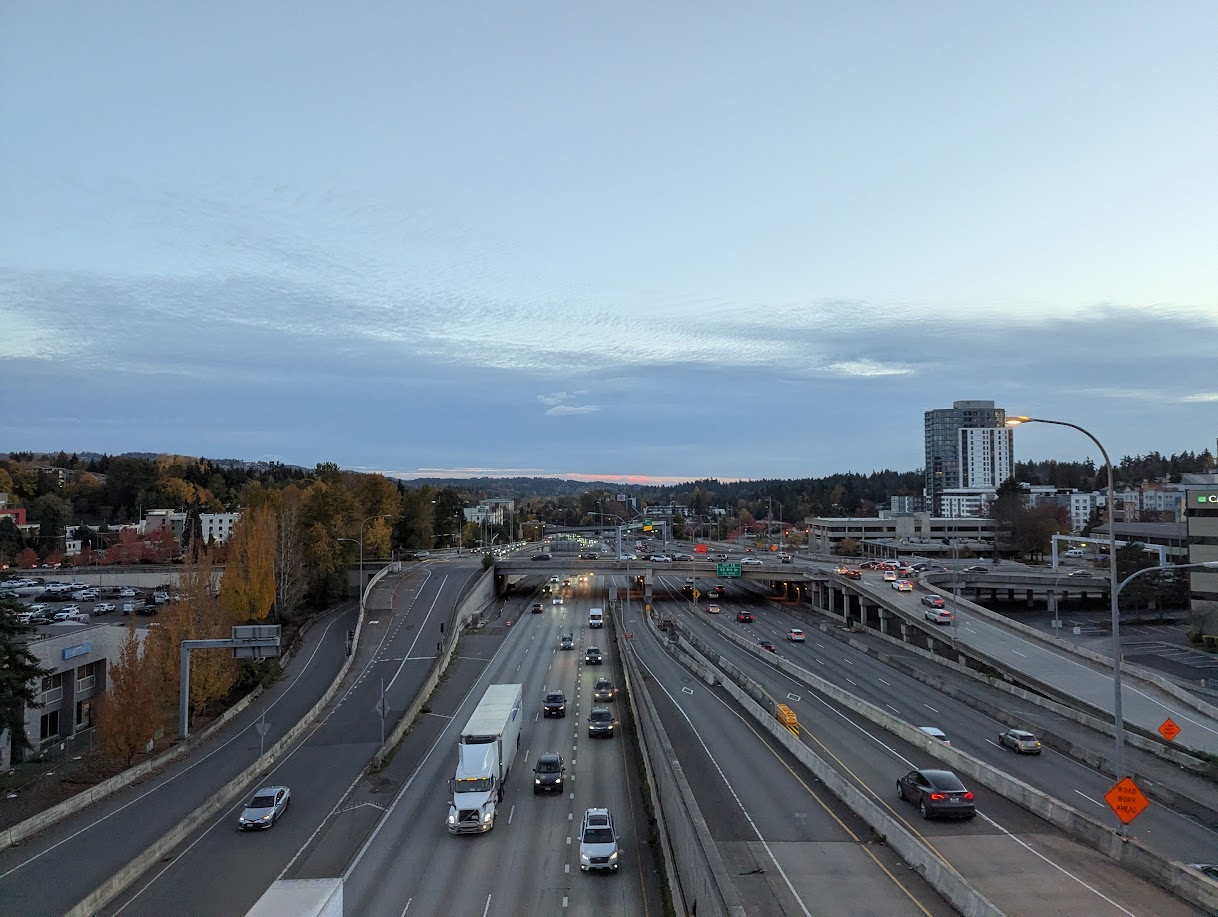
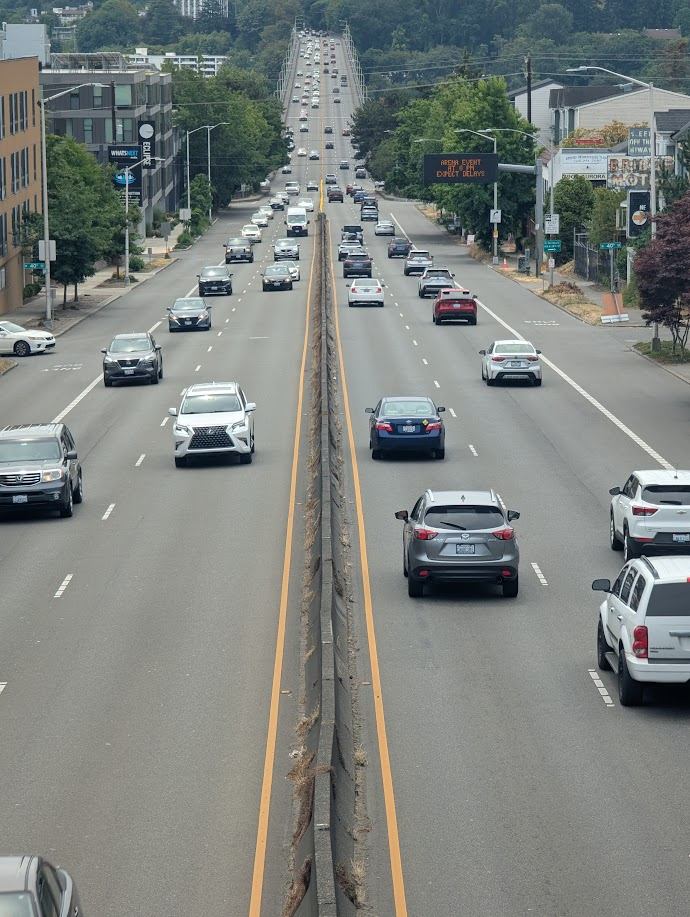
Look carefully at the design of an American city. What do you see? Obviously, a lot of freeways and not a lot of sidewalks. But look deeper. Where do those freeways go? What do they connect people with? And how long are the freeways? American cities are designed to connect people living in very spaced-out housing that is very far away with slightly less spaced-out offices and work areas. Not much thought is given to anything else. Cities are designed exclusively around the concept of managing the volume of car traffic. Even now, with the new urbanist movement in America, the arguments that have gathered the most traction are the ones around peak capacity. Not around access or travel times.
The city of Seattle is trying to place a sidewalk on every street by 2050. That's great. But nobody will use them if it's still a bunch of detached single family houses, where building anything resembling a point of interest has been illegal for nearly a century. Everyone wants the freedom and flexibility of the Japanese train system. But not as much thought as given to what it actually implies for you to need stations that are ~3 miles apart with a train every 5 minutes. Each one of those stations justifies its existence by serving tens or hundreds of thousands of daily passengers. American cities are designed in a way where we'd need 5x more train to serve 1/5 as many people.
There is a sentiment that American cities are badly designed. That's not true. They are badly designed if your goal is to produce a city that is pleasant to live in, sure. Badly designed for people with disabilities. Badly designed for poor people. But cities in America were never built with the goal of improving the quality of life of the general public. That's like, maybe #7 on the list of priorities in the design of an American city. Some other priorities that rank higher include (roughly in order of importance):
- Ensuring poor people do not have access to rich areas
- Preventing homeless people from surviving
- Preserving the value and existence of as many single-family homes as possible
- Maximizing the amount of car traffic that can reach businesses, especially large retail stores
- Improving safety (for people in cars)
- Not fundamentally changing anything about the city ("preserving neighborhood character")
When you consider these priorities, the design of American cities is actually genius. Every "anti-feature" of American Urbanism actually serves a purpose. The lack of public transportation and pedestrian infrastructure means you immediately have to spend thousands of dollars on a car just to access essentials. This also has the benefit of making it prohibitively expensive to actually go anywhere in most cities, while simultaneously making it necessary. That means Americans are accustomed to spending hundreds of dollars a month just on transportation, and they don't think it's weird. The mass amounts of low-density suburbs strangling every downtown core means that poor areas are very easy to segregate from rich areas. The most effective defense is distance.
In addition, the huge sprawl of low-density single-family housing makes it economically and politically challenging to increase density in any one particular spot. You can deny new infrastructure on the basis that there isn't enough density to justify it, and you can deny increased density on the basis that there isn't enough infrastructure to support it. This creates a virtuous cycle of cities actually getting even more spread out as they grow instead of increasing in density. And of course, the huge amount of sprawl means that there is a ton of space for infrastructure, so something like a 10-lane freeway isn't a big deal and is indeed commonplace, even in cities with populations in the low 100Ks. Talk to a civil engineer and they'll happily explain to you the importance of preserving neighborhood character and maximizing traffic volume. Traffic volume is measured in "cars per hour", by the way. Pedestrians are something that get added to designs at the end, if there's extra time, and extra money. Just throw a sidewalk and a crosswalk on there. But only in places where it won't complicate car traffic.
This creates a chicken-and-egg problem. All of our infrastructure is designed around what people are doing today, when the infrastructure doesn't exist. Even in cities where they ostensibly want more people to ride transit, the traffic engineering plans seem entirely based on today's world instead of the world they want to build. The end result is that we get city planners, with a completely straight face, telling us that they hope to increase the share of trips using public transit by investing exclusively in improvements for car traffic.
The large emphasis on preserving the value of homes also leads to an insane combination of absurdly high cost of living with very poor infrastructure. Each house is priced to the ceiling of what consumers can afford due to the carefully-engineered shortage, and then due to the (government-mandated) spacing between houses, it becomes prohibitively expensive to actually serve houses with sensible, modern infrastructure. So most Americans either do without, or, more commonly, pay for it themselves. In America, a status symbol is owning a house where you have automatic backup generators. Because random power outages are just a fact of life here. And rich people counterintuitively tend to live in areas with worse-than-average infrastructure. All the "nice" houses are in the middle of nowhere.
I have coworkers who own multi-million dollar mansions and end up relying on T-Mobile fixed wireless for internet because the only wired internet they can get is a shitty copper cable that doesn't even work half the time. This is the case in some of the richest areas in the country. Making matters worse, everyone wants to feel rich, so even the areas that can't really afford to build everything so far apart end up doing it anyway. After all, property developers don't really care about the quality of the infrastructure. That's the city's job. They care about how easy it is to get approval for projects. And even if essential infrastructure is missing, that just becomes a cost that is passed on to the consumer in the form of septic tanks, wells, satellite internet, and in some cases, entire off-grid power systems.
Americans pay a premium to live in the most antisocial, remote places possible. It's considered normal in America to say something like "My dream is to live in a house in the mountains, far away from everyone, where nobody can bother me". That is not considered to be a deranged, antisocial statement. This is a hot take, but if you, as a human, want to live as far away from other people as possible, you are mentally ill. But what do you do when mental illness is seen as a fixed element of your culture?
The insanely high cost of housing means, naturally, homelessness is a major issue. And Americans have perplexingly chosen to make it harder to be homeless instead of making it easier to not be homeless. But I digress, this is really about people at the end of the day. So let's talk about the impact of all of this to the average person.
The consequences of this type of city are broad. Because of this, everyone uses cars, which are the single most antisocial form of transportation ever invented. Then, even if cities do invest in public transit, most of the routes are going to be running empty buses for half the day and will max out at 7 passengers the other half. It's not just because the bus service is bad. I can't tell you how many Americans I've met refuse to ride public transit even when a given route is convenient, safe, and affordable. You can save like $100 on Uber by instead taking public transit out of SeaTac and yet I've never met anyone who actually does it. It's not that nobody does it, but it's an option that few people seem to even acknowledge, much less choose.
I took my sister to a movie recently, and didn't want to try parking downtown. But that's fine. There's a new light rail with a giant parking garage near my house that can take us there. So I suggested we use it. She spent the next half hour trying to awkwardly come up with some reason why that was a bad idea. When she ultimately failed, and we took the train, she was visibly annoyed at having to do it. And my sister is a highly progressive person who, in principle, is very supportive of public transit. There's an old Onion headline: "93% of Americans support other people using public transit". Urbanists are correct that more people will ride transit if it's good, but I am very confident America will always have lower ridership than other countries, even if we make larger investments. And we make bigger investments than you might assume. Our investments just suck.
The spaced-out housing makes transit times inherently long. Even if we did build quality sidewalks and delivered frequent bus service, it would still take forever to get anywhere because everything is just so damn far apart. Remember back in part 2 of this series where I talked about how long it takes just to get a group of five people who already live in the same area into the same room. Public transit will always be far more efficient than freeways, but it's basically never going to be faster, unless you take traffic congestion into account, or build high-speed rail (which isn't used for local trips). And travel time is a far more important consideration to Americans than efficiency.
I will say, I think Americans value time too much. I get the sense that the average American cares way more about the principle of their time being wasted than the reality of it. The truth is, as mentioned in the previous article, Americans place a pretty low value on their time. They waste it constantly. What they hate is when someone else tries to take it.
In addition, Americans don't really know what they're missing. In general, American cities either have no public transit, or they have a very thinly-stretched network that attempts to serve the entire city. New investments almost always go into network expansion rather than improving the existing service. The result is that even when it exists and is available, it's rarely a viable option for our most common trips (groceries, work, dinner) and is basically never convenient. That means public transit equals bad, everywhere you go. I think this is actually solvable.
When America didn't have paved roads, and cars were more of a novelty than a serious mode of transportation, there were groups who wanted to change that. So they would, at the edge of a town, build a single mile of paved road. These were called "Seedling Miles". They would then invite the public to drive out to them and try them out. The horrible, bumpy, inconsistent ride to reach the seedling mile was put in stark contrast with this beautifully-manicured mile of pavement. And it worked. People saw how good a paved road can be, and they wanted one.
We could do the same thing with public transit. We could, instead of serving everyone, focus on delivering exceptional quality service for a few specific trips. And make public transit the desirable option for those trips. Then the conversation becomes "Let's get this to more places" instead of "Just a few billion dollars more and the buses will be usable bro I promise". Some cities in America, particularly Seattle, have accidentally done this. Everyone wants light rail in their area now because they delivered reliable, convenient, 8-minute train service. And the people who have had the chance to ride it are overwhelmingly supportive of its continued expansion. But this is still going to take decades to fix for all the reasons I mentioned above.
There are other consequences to poor transit access too. Like for example it's extremely difficult to organize a protest in America, because our cities make it impossible to get large numbers of people to the same place at the same time. And ironically, privacy is a lot better in a system you can just walk into and out of, compared to a system where you have to pay fees to register a vehicle with all your personal information, where you then get assigned an ID number, that you must display at all times. I'll remind you that the main reason Flock cameras are so effective is because you have to drive to get anywhere...
At the end of the day though, people know all of this. I'm not presenting any new information. And, like it or not, the system that produced these cities was a democratic one. As much as I'd like to blame a small number of rich assholes for all our problems, the reality is that it was democracy that produced this result. Americans like their antisocial bubbles and antisocial neighborhoods. They literally voted for this. The onerous review process that prevents denser housing from getting built is something people want. When local politicians try to remove these hurdles, they lose elections.
In Kirkland, the city council is very urbanist by American standards. They have made significant investments in pedestrian infrastructure and public transit. They are just wrapping up a multi-million dollar project whose primary purpose was to improve the reliability of bus routes. When the state said "Every city must now approve at least 3 of these 8 multi-family housing styles", Kirkland approved all 8. But one day the city council decided to vote on whether to legalize mixed-use zoning city wide. Let's bring back neighborhood cafes they said. In principle, this change would have done very little, because every project still had to be approved by the city. It merely opened the door for the option.
That didn't matter. The backlash was swift and violent. And the council immediately walked it back. The next election, the urbanist incumbents only very, very narrowly kept their seats against candidates whose platforms were saying things like "Kirkland city council has gone crazy" and "We need to take back Kirkland". All because the council wanted to legalize the concept of putting a restaurant next to a house. Again, this is arguably one of the most progressive urbanist cities in America...
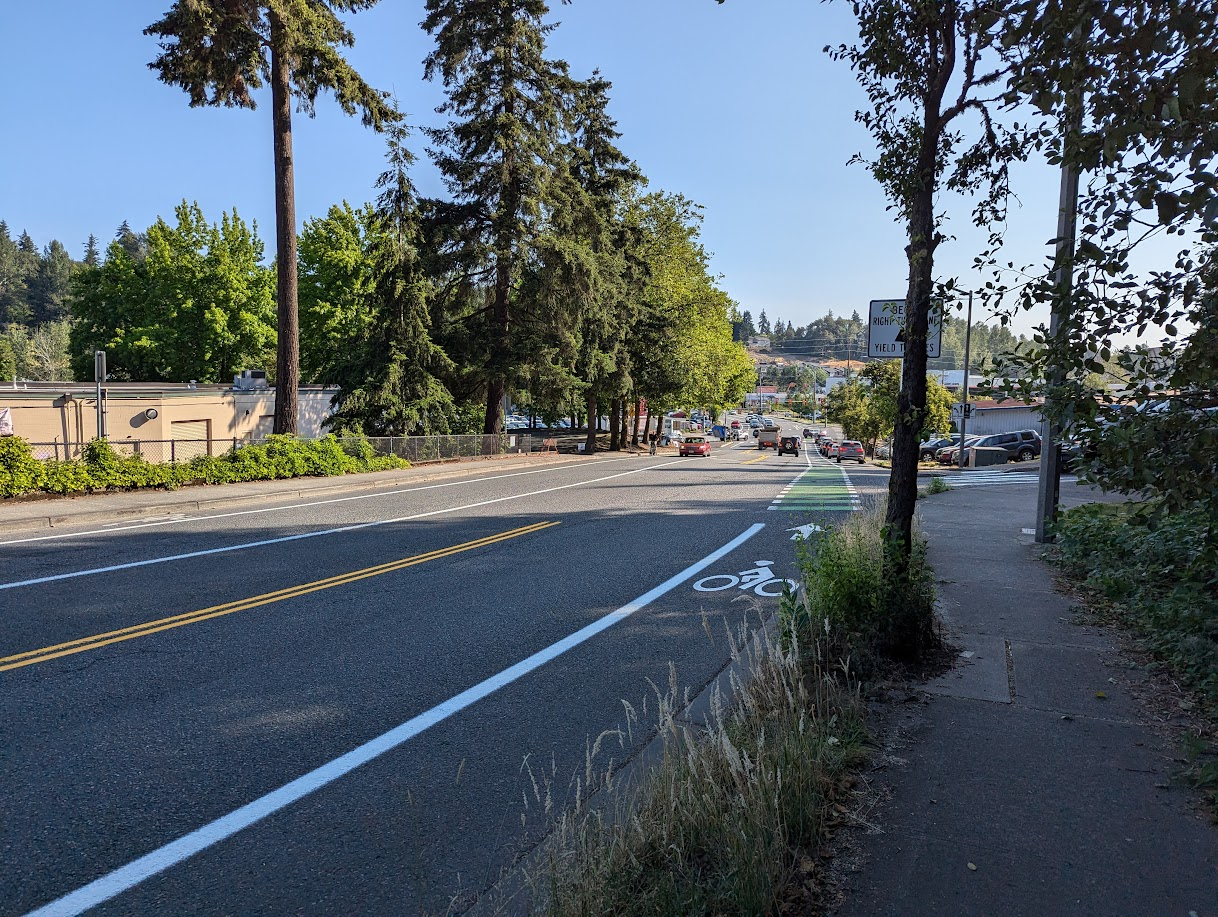
You can tell it's urbanist because the bike lanes are painted.
I've heard numerous excuses for why seemingly so many people want something different than what the election results say they want. The political process is inaccessible. The NIMBYs have more time than me. But it's your city. It's the world you live in. What do you mean you don't have time to fight for it? You already know from the previous article that I don't consider a lack of time to be a valid excuse. If you cared, you would do something, right?
I paid close attention to that election I mentioned a couple paragraphs ago. The election seemed like a potential turning point for the city. So I did the bare minimum, I voted, and I encouraged my roommates to also vote. I didn't tell them who to vote for, I never will. But I simply told them this looked to be a pretty important election, so they should make sure to cast their ballots. By the way, for non-Washingtonians, I should give some context. In Washington, every single voter receives their ballot by mail. They can complete it at any time, sign it, then either mail it back or drop it off in one of many hundreds of ballot drop boxes located throughout the state. Usually you have about two weeks to do this. No witness signatures required, no waiting in line, no filling out a form ahead of time to specially request an absentee ballot. We have possibly the easiest voting process in the country, and probably one of the easiest in the world. The idea that it would be "too hard" to vote in this state is frankly absurd. Anyway.
In general, the responses I got were along the lines of "Meh". One of my roommates reacted in a way that caught me completely off guard though. He laughed, with a noticeable twinge of frustration, and forcefully replied "I'll be honest, I'm not going to fucking vote. I don't give a shit. I'm a renter. I'm only here temporarily anyway." He said those words to me like he was spitting out a hair. I was speechless. I just stared at him in shock until he left.
I don't understand this mentality. But it would be naive to think it's particularly uncommon when the typical voter turnout in local elections hovers around 30%. This conversation has been stuck in my head ever since. I can't stop thinking about it. That short exchange, whch only lasted around 20 seconds at most, marked the point where I suddenly realized why this country ended up the way it did.
Part 5 is next week.