
Art by corin
In my previous article, which you can find here, I concluded my diatribe about why Americans are so antisocial with a lengthy rant about the state of local politics in America. With all that said, let's see what we learned.
The thing unifying all of this. The reason we keep building our antisocial cities, the reason we keep struggling to spend time with people, the reason everyone always seems to be tired and busy and unavailable.
Nobody gives a fuck.
Being on your phone is easy. Going to work is mandatory. More than half of young adults can't even be bothered to vote. And hanging out with your friends is way more work than that, for something that probably matters less.
So obviously it's hard to get people to do it. It might be good for them, and they might enjoy it, and they might wish they did it more. But that is massively outweighed, nearly every time, by the fact that it is inconvenient.
When my friend group fell apart, nobody cared enough to fix it. Sure, I cared, but it's not much of a friend group when it's one person. And that seems to be what is happening in this country at every level. In politics, in law enforcement, in urban planning, in workplaces, in relationships. I cannot tell you how many places I've been here, how many contexts I've seen this exact pattern of behavior: Shit's fucked, everyone agrees it's fucked, and so much time is spent griping at each other about how fucked it is, but when it comes time to actually do something about it? Crickets. If someone does something, we spend more time criticizing them for doing it wrong than we spend doing anything ourselves.
We all agree billionaires have amassed too much power. We also all agree that wealth is their source of power. And we all agree they don't pay their fair share of taxes. Yet, when someone proposes a wealth tax, a bunch of random people come crawling out of the woodwork to say it won't work and we're wasting our time. Do they have an alternative? No. Seemingly, the plan for these people is to just let everything go to shit. Because continuing on a path that isn't working is apparently better than trying a different, potentially flawed idea. Maybe I'm an idiot, but I think doing something stupid is better than doing nothing.
This series is titled "Death to America" not because I wish for America to die. I so badly want things to reverse course. But, from behind a screen, I can only present the information. I can give it emotional appeal, I can make you feel like you did something, just by reading it. I can give you a moment of resolve. But that resolve will fade in a matter of seconds. I don't think anything will change until people get so broken and confused and hurt that they can't go on living like this anymore. It's not bad enough yet. You might want me to tell you how bad things are going to get. And to answer that:
How bad are you willing to let things get?
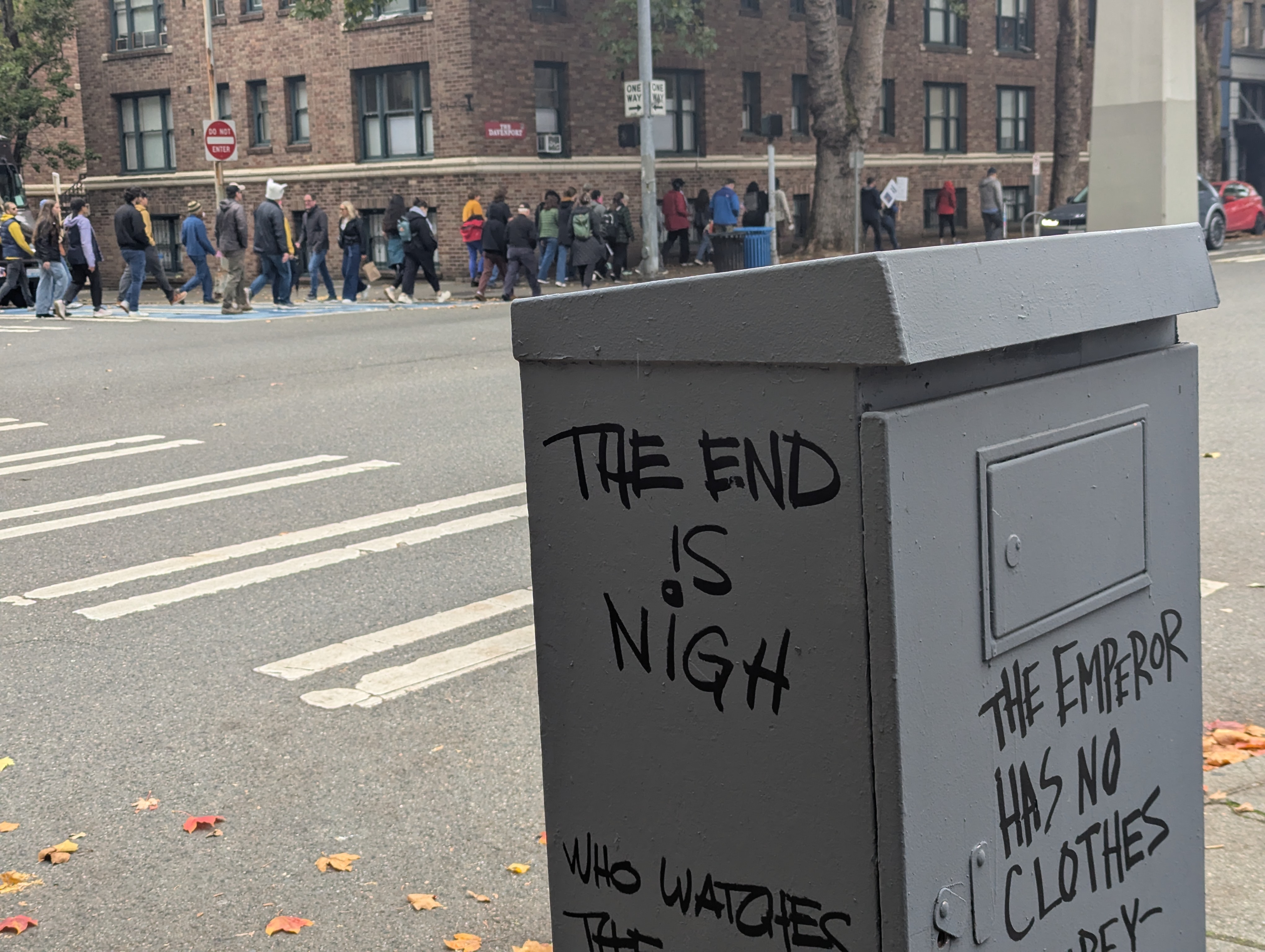
For about the last 10 years, we've witnessed the developed world slip into a psychotic, self-destructive rage. The crazies are winning. The paranoid conspiracy theories are all true. The idea that Jeffrey Epstein didn't kill himself and was instead murdered in such a way that his killer still has not even been searched for, much less caught, is not just an edgy joke or fringe conspiracy theory. It's widely believed to be true.
And for pretty much this entire time, we have mostly blamed this on "radicalization", or "polarization". Fake news, misinformation, psyops, whoever you want to blame have become an expected feature of our world. Only in the 2020s can you visit so-called "social media" to see four-sentence articles by so-called "journalists" accusing people you've never met of crimes that would have gotten you lynched less than a century ago, only to then see other strangers, who also have no relationship with the accused, go on to defend their alleged behavior as being not only rational, but just. This is what passes for discourse nowadays. The Overton window hasn't shifted, it has simply broken. It doesn't matter how clear-cut an issue is, there will always be someone on the other side of it.
And that's bad, right? And it's because of radicalization, right? If we all just went back to having a single, shared reality, then things would not only go back to normal, but would also improve. The way people talk about it, I think a common sentiment is something like "The problem is that we have all these crazy/stupid/evil people in politics, and we need to just get rid of them so that the normal people can be in charge". Obviously, this line of thinking immediately falls apart when questioned. But let's not stop there. Let's think about what that implies.
If the answer is not to just start kicking people out of politics for "being too radical", what other options do we have? Well, we could start by trying to de-radicalize everybody. But how do you propose we accomplish that? More authoritarian control, probably. If people wanted to be de-radicalized, they would probably seek out the information needed to do that on their own. That means if the goal is to de-radicalize people, it needs to be done without their consent. So, ultimately, whatever solution we have to this problem is going to require some kind of authority figure. Something is going to have to be forced on somebody. And we're all hoping it'll be the other guy.
Let's say we don't like the sound of that. Arguably, that's how we got into this mess in the first place. What else is there? Well, we could instead assume that people trend towards the middle over time naturally, and focus on eliminating sources of radicalization. We could view moderates as the "natural state" of political belief, and therefore anyone who strays from there must have been corrupted by an external source. Unfortunately, it turns out in practice that there is basically a 1:1 overlap between "sources of radicalization" and "sources of information". We get radicalized by information! Who knew? You cannot stamp out radicalization without stamping out communication in general.
And besides, it's not like being a "moderate" means anything anyway. The last generation's radical leftists are today's progressive democrats. Today's radical right-wingers are tomorrow's mainstream conservatives. Trying to return to a past definition of moderate is, by definition, regressive. So, in my mind, eliminating radicals would necessarily require eliminating progress too.
Now, you could make the case that the real reasons people are becoming radicalized are economic. It's always the poor people. See, when you get desperate, you start having crazy ideas. This sounds reasonable at first, but when you consider the implications, it's utterly ridiculous. It should follow that billionaires are the least radical people on the planet. And it should also follow that if you give someone money, they'll become less radical. That is so obviously false. Everyone is getting more radical, even people whose economic status is improving. So, I am unconvinced of this economic argument. There are too many counterexamples.
Okay so, we can't de-radicalize people ourselves, and we can't stop people from getting radicalized. What hope do we have?
I have a radical suggestion. Let's just accept radicalization as a feature of the modern culture for a little bit. Instead of trying to architect a new shared reality with everyone, let's just let all the competing realities fight it out. After all, who's to say the shared reality we had before was correct? That shared reality led to the world we're in now. Maybe it's a good thing if everyone has their own competing idea of what is true.
The key thing here though, is that we still need people to be social. When people insulate from the real world, that's when the delusional realities thrive. People still need to face consequences for their beliefs. That's how we calibrate ourselves. If your beliefs carry no consequences, then they carry no meaning. When was the last time you stood up for something? What was the last thing you sacrificed because it was what you believed was right? If your beliefs are not challenging you on a fairly regular basis, then either your beliefs are lame as hell, or whatever beliefs you have are extremely weak.
If you believe we should try to end homelessness, but you have taken no steps to change the state of homelessness, do you really believe that? There's a word for a belief you never actually act on: It's an opinion. Let's not confuse the two. If you merely hold the opinion that we should end homelessness, your mind is probably something like: "If I had a button that would end homelessness, I would totally press it", but you're unwilling to do stuff like attend protests, help out at shelters, or even attend city council meetings that are deciding things like affordable housing projects. If your "belief" only activates when someone brings it up, that's an opinion.
I have two strong statements to make here. One, you should have a lot of beliefs. Two, you should not have a lot of opinions.
Why should you have a lot of beliefs? You should have a lot of beliefs, mainly, because beliefs are cool. Having beliefs makes you more interesting, more valuable, and more good (in the moral sense). If you have beliefs, you will inevitably signal those beliefs to other people. Your environment WILL change, and you WILL influence the people around you. In addition, if you encounter people with competing beliefs, and they're smart, they will confront you on those beliefs. And at least one of you will learn something from that. This will, during the course of your lifetime, have exponential benefical effects as your personal philosophy becomes more nuanced and complete.
Why should you have few opinions? Well, simply put, opinions are lame. If they signal agreement, they do so without commitment, which is useless and a waste of time. If they signal disagreement, they create discontentment for no real cause. Definitionally, opinions are things you don't really care about that deeply (otherwise they would become beliefs), so there is very little to be gained arguing over opinions except for increased skill in arguing. If you have any opinions, you shouldn't share them very often. Ideally, you wouldn't share them at all. Their one legitimate value is in giving you a starting point from which you can form a belief or hold a conversation with someone else who has a belief.
If you hold an opinion that taxes ought to be lower, and I hold a belief that taxes ought to be higher, then you should yield to me by default. If you're not willing to yield, then it's for one of two reasons. Either your opinion is actually a belief, or, more likely, you are narcissistic and egotistical and have a problem with the notion of other people being wrong when you are so obviously right. As an egotistical narcissist, you can trust me on that.
The logical conclusion of trying to hold more beliefs and trying to strengthen the beliefs you have is that you will appear more radical over time. I maintain that is a good thing. To be radical is to be growing. To be radical is to take life and the issues before you seriously. To be moderate is, in my eyes, to give up. That's not to say any one radical possesses all the answers, or that you should devote your life to any one ideology. Nor is it to say that people who see and acknowledge the complexities of the real world are somehow weak and complicit in its decline. Instead, I make the following claim:
If you talk to twenty self-described "moderates", "independents", or "centrists", you will not find even one who holds more beliefs than the very first self-described "anarcho-capitalist" you can find. And consequently, you will learn far more about the world from the one radical than you will from the twenty moderates.
So is it really a problem if everyone becomes a radical? I contend that it isn't. People say the problem is that there are too many crazies in politics. I say the problem is that there aren't enough of them. We need people more politically active, more politically engaged, more subversive, and more thoughtful in their beliefs. Because the one ideology that has been proven, time and time again, to never ever work, is no ideology at all. Moderates lose to fascists every time.
In part 6 I will conclude this series and explain what this was all about. See you next week.